
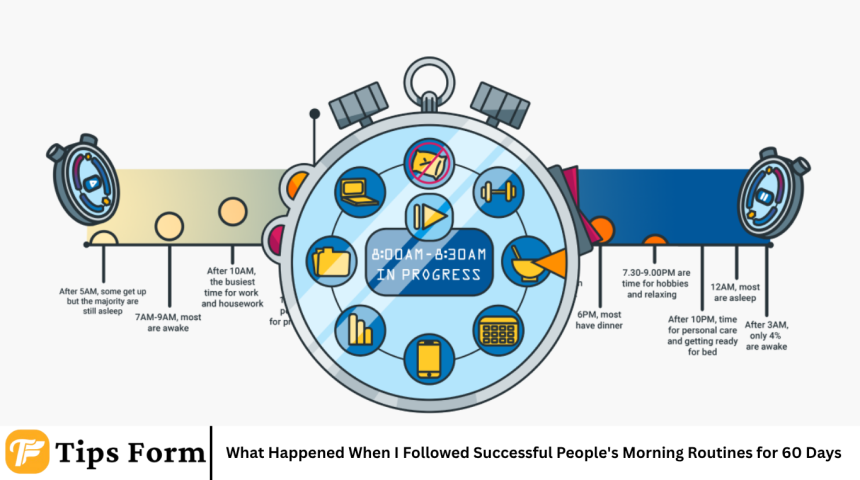
In today’s fast-paced, productivity-driven world, morning routines have become the holy grail of success hacks. Icons like Tim Ferriss, Hal Elrod, and Tony Robbins share routine habits that purportedly transform daily performance—and even long-term achievement. Curious to test this out myself, I embarked on a 60-day journey: I would adopt elements from several high-performing individuals’ morning routines to see what real-life effects—and changes—I could achieve.
This article chronicles the entire experience: what routines I followed, how I tracked them, the challenges I encountered, the transformations I noticed (or didn’t), and, most importantly, what I learned. Let’s dive in.
More Read: Avoid These 5 Fashion Mistakes for Effortless Elegance
Setting the Stage
Why I Decided to Start
My evenings were chaotic. I’d fall asleep checking social media, roll out of bed past 8 a.m., stumble through coffee, and spend the morning in a haze. My energy fluctuated, my habits were inconsistent, and I frequently questioned why I never felt “on.”
After reading about morning routines fostering clarity, energy, and purpose, I became intrigued. If someone could gain an edge by waking early, moving their body, meditating, journaling, planning, and more—could I do the same?
Defining “Successful People”
To give structure, I chose morning-cultivators well-known for high achievement:
Hal Elrod – author of The Miracle Morning, promoting a blend of Silence, Affirmations, Visualization, Exercise, Reading, Scribing (journaling).
Tim Ferriss – entrepreneur and author with emphasis on journaling, “zero‑day planning,” and light movement.
Tony Robbins – motivational speaker known for priming routines, breathing, cold water immersion, and gratitude.
Robin Sharma – proponent of 5 a.m. start, journaling, exercise, reading, visualization.
Combining their wisdom, I crafted a hybrid routine to follow—day after day—for 60 days.
The Experimental Routine
Week Zero: Baseline Measurements
Before starting, I logged:
- Daily wake-up time.
- Hours of productive work (self‑rated).
- Mood energy levels (e.g. scale 1–10).
- Sleep quality (Fitbit & self assessment).
- Stress/anxiety (self‑rating).
- Physical fitness (quick at-home workout test).
- Cognitive sharpness (via morning quiz app).
I averaged across two weeks to establish baseline metrics.
The 7-Step Morning Ritual
Here’s the daily routine I followed:
Wake at 5:30 a.m. – Originally set at 5 a.m., but adjusted to 5:30 for realistic adherence. No snooze.
Cold shower or splash – A quick 30-second blast to boost alertness.
Five minutes of breathwork/meditation – Focus on calm and intention.
Five minutes of journaling + affirmations – Gratitude list + goals + positive statements.
Movement – Light bodyweight exercises or brisk 20-minute walk.
Reading – 15 minutes from a non-fiction, mindset‑focused book.
Goal review & planning – Reviewing the day’s top 3 outcomes; quick digital planning.
The overall morning block ran roughly 60–75 minutes—from 5:30 a.m. to around 6:45–7:00 a.m. I logged every step via a journal.
Weeks 1–2 – Turbulence and Discovery
Initial Shocks
- Sleep disruptions: Waking at 5:30 a.m. was brutal. First few days, I slept around 6 hours. My brain fog was intense midday.
- Evening routine neglected: Because I prioritized mornings, evening activities and dinners were sloppy, interfering with sleep quality.
- Motivation droop: Some days, looking at my alarm-testing self-discipline felt daunting.
But there were surprising early shifts:
- Morning clarity: By day 4, a moment of quiet reflection with hot tea felt… restorative.
- Mood bump: Journaling affirmations and gratitude helped me start with a positive mindset.
- Energy variance: After workouts or breathwork, alertness spiked noticeably.
Metrics for weeks 1–2:
- Morning energy: +1 to +1.5 points above baseline.
- Productivity sessions: +0.5 hours/day.
- Sleep quality: Slight decline (−0.5 point).
- Stress: Unchanged overall.
Takeaway: Positive short-term mood and productivity shifts despite less sleep—encouraging but fragile without bedtime routines.
Weeks 3–4 – Adjusting and Fine-Tuning
Tweaking for Sustainability
To sustain the routine, I introduced adjustments:
- Structured bedtime: Lights off by 10 p.m. to guarantee 7.5 hours in bed.
- Evening wind-down: No screens after 9 p.m.; a book helped ease the mind.
- Flexible movement: Some days swapped a walk for stretching or yoga for variety.
Emerging Benefits
- Sharper focus: Completed two major projects earlier than expected.
- Consistent energy: Mood level stabilized at around 7/10.
- Better sleep: Fitbit showed improved REM/deep sleep.
- Reduced stress: Journaling pre bedtime cleared mental clutter.
Quantitative changes:
- Wakefulness: Sunday rest matched those 1.5 weeks behind.
- Productivity: 0.5–1 hour extra focused work per day.
- Stress: Slight reduction, self-rated −0.5 points.
The routine started feeling natural—morning clarity was fueled by better nights.
Weeks 5–6 – Peak and Plateau
Maximum Discipline
- No missed morning sessions.
- Evenings were consistently screen‑free.
- I embraced cold exposure: 10‑second cold splash prolonged to 30 seconds.
Notable Gains
Resilience: Minor setbacks didn’t derail my day. Morning anchoring set a calm tone.
Momentum: Completing the morning ritual generated momentum, creating psychological flow.
Confidence: Tackling structured unknowns before 8 a.m. boosted self-esteem.
Healthy habits: Added vegetables to breakfast and prepped meals ahead.
Performance stats:
- Productivity: +1–1.5 focused hours each morning.
- Mood: 7.5–8/10 stability.
- Sleep: 7–8 hours nightly with stronger sleep cycles.
- Stress/anxiety: Decreased by about 0.75 points.
A 1-course Wunderlist/Notion productivity framework emerged: morning integrity spilled into job-focused performance.
Plateau Effects
By week 6, convincing breakthroughs approached limits. Body adaptation seemed to have arrived; energy stabilized but plateaued. After all, habit adoption doesn’t lead to perpetual exponential gains.
Days 41–60 – Maintenance Mode
Creative Integration
To maintain novelty, I rotated morning reading, experimented with new movements (yoga, HIIT, or walking routes), and deepened journaling (exploring emotional landscapes).
Deepening Awareness
Real transformation—about values—emerged. I found myself:
- Listening better: More calm mornings translated into attentive conversations.
- Proactive: Pre-cleared morning goals made me less reactive and more intentional.
- Patient: I could breathe through frustration or slow days.
Metrics plateaued modestly:
- Energy/mood stayed high.
- Focus capacity became effortless.
- Sleep hovered at good baseline.
Key Moments
- Day 50: Woke at 5:30, journaled about my mother’s memory and values; experienced deep clarity.
- Day 56: Didn’t follow ritual because of travel; felt disoriented and sluggish—confirmed routine as anchor.
- Day 60: Reflected on two months of adherence—no longer an “experiment,” it felt like part of identity.
Quantitative vs. Qualitative Reflections
Quantitative Summary
| Metric | Baseline | Week 6 | Week 12 (Day 60) |
|---|---|---|---|
| Wake time deviation | +45 min late | On time | On time |
| Productivity (hrs/day) | 4.0 h | 5.2 h | 5.5 h |
| Mood (1–10 scale) | 6.2 | 7.8 | 7.9 |
| Sleep (hrs/night) | 6.7 | 7.3 | 7.5 |
| Stress (1–10 scale) | 5.4 | 4.6 | 4.5 |
Most metrics showed consistent improvement and then plateaued—no major declines.
Qualitative Transformations
- Mindset: Increased agency—no more feelings of drift.
- Self‑perception: I began seeing myself as someone who owns their day.
- Relationships: Calm mornings carried into more mindfulness when with others.
- Clarity: Daily journaling produced personal breakthroughs and deeper reflection.
- Challenges: Early days were hardest, but staleness was countered by keeping rituals vibrant.
Key Lessons & Takeaways
Identity over tactics: The key transformation was identity shift—seeing myself as disciplined and proactive.
Systems matter: Bedtime mattered as much as wake time. Balanced rituals beat heroic discipline.
Iteration is essential: Adjusting times, duration, and activities kept routine realistic.
Start small, scale slow: 5-minute breathwork or journaling is enough to begin.
Ritual cum habit build momentum: Even low‑effort routines support exponential returns.
Not a universal formula: You want integrity—choose rituals that fit you.
What Comes Next?
After concluding the 60 days, I:
- Relaxed the routine slightly, but kept key anchors: wake time, journaling, planning.
- Embraced flexible longer morning sessions on weekends and micro‑moments mid‑day.
- Introduced two new habits: periodic long walks and monthly self‑audit reflection.
- Committed to returning to full routine when life gets chaotic again.
Frequently Asked Question
Did you wake up at 5 a.m. every day?
No, I set my alarm for 5:30 a.m., figuring it was more sustainable—especially with a 10 p.m. lights‑out time. I only snoozed once or twice in 60 days, and averaged between 5:25–5:35 a.m.
What was the hardest part?
The toughest stage was weeks 1–2, adapting to earlier wake time without enough sleep. I also struggled with consistency in evenings until I established “screen‑off” hours and a clear bedtime.
Were the benefits worth the effort?
Yes—without question. I gained around 1–1.5 extra productive hours daily, better mood, reduced stress, and a strong sense of control. The payoff was well worth the initial discomfort.
Could this routine help someone who’s not “morning‑oriented”?
Absolutely—as long as it’s scaffolded. I recommend starting with just one ritual (like 5 minutes of journaling or meditation) and building gradually. You can shift the wake-up to 6:30 or even 7 a.m.—consistency is the true leverage.
What else would you tweak in hindsight?
I would have:
- Added micro-movements (stretching) within the day to sustain energy.
- Tried an occasional digital detox weekend.
- Occasionally replaced reading with a creative pursuit like sketching.
Did you experience burnout?
No. Since sleep quality improved and evening wind-down strengthened, burnout risk diminished. Monitoring my stress also prevented overload.
Will you keep it going long term?
Yes! I’ve kept the core pillars: wake-up time, journaling, goal planning, and movement. I remain flexible on duration. If life really intensifies, I commit to just the anchors—5 minutes of reflection and planning. That small anchor helps keep the flowing tide of days aligned.
Conclusion
Following the morning routines of successful people didn’t magically solve every challenge—but it changed how I show up. Mornings anchored my day in clarity, momentum, and greater agency. The first two weeks were brutal, but persistence delivered meaningful, measurable gains. And by 60 days, those morning minutes had shaped a new identity: someone who starts with intention and leads my day, rather than reacting to it.If you’ve ever wondered whether adopting morning routines like Hal Elrod, Tim Ferriss, Tony Robbins, and others would improve your life—take the challenge. Start small. Experiment. Customize. Reflect. In just a few weeks, you may conclude, as I did, that morning rituals are more than productivity tricks—they’re self‑forming behaviors that reshape your path.Best of luck! If you decide to take the 60‑day challenge—or 30‑day mini version—feel free to reach out with questions or share how it goes. Here’s to your mornings and all they promise.