
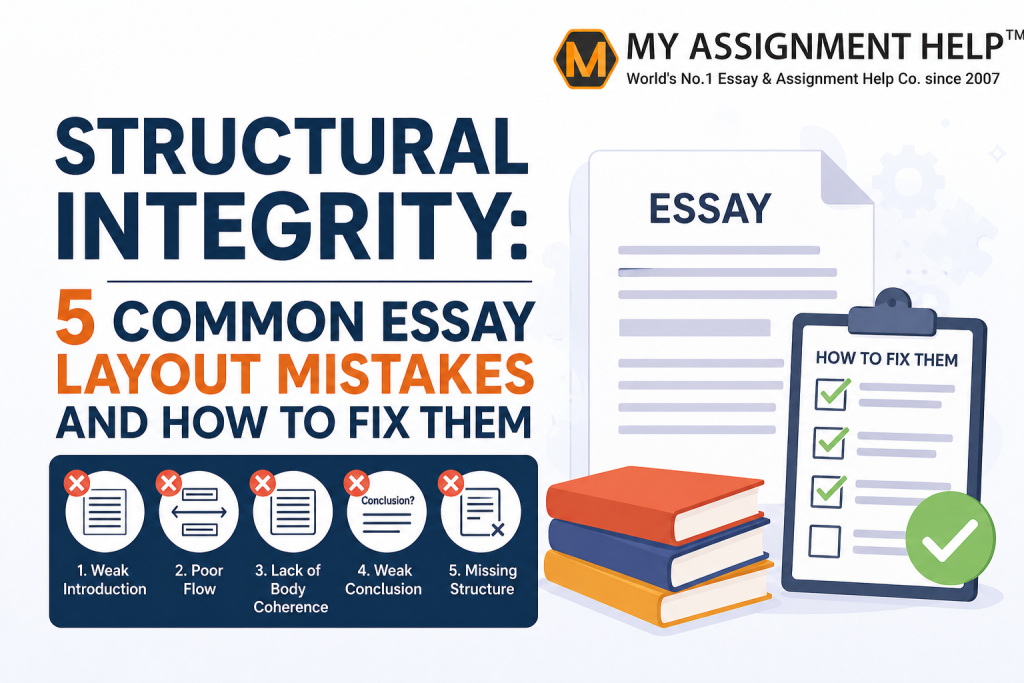
Writing a great essay is a lot like building a house. You can have the most expensive windows and the most beautiful paint, but if the foundation is cracked, the whole thing will eventually fall apart. In the world of academic writing, that foundation is your layout. Many students spend days researching facts and polishing their vocabulary, only to receive a lower grade than expected. Often, the culprit isn’t the quality of their ideas, but the way those ideas are organized. When a reader gets lost moving from one point to the next, the impact of the argument is lost.
Mastering the basic Essay Structure is the first step toward academic success. It provides a roadmap for the reader, ensuring that your introduction, body paragraphs, and conclusion work together as a single, cohesive unit. When these elements are out of alignment, the “structural integrity” of your work is compromised. By learning to identify and fix common layout errors, you can turn a confusing jumble of thoughts into a persuasive and professional piece of writing.
1. The “Floating” Thesis Statement
The thesis statement is the most important sentence in your entire essay. It tells the reader exactly what you are going to prove. A common mistake is burying this sentence in the middle of a paragraph or leaving it out of the introduction entirely.
The Fix: The Anchor Placement
Your thesis should be the “anchor” of your introduction. Usually, it works best as the very last sentence of your first paragraph. This position allows you to start with broad context and narrow down to your specific argument. If your thesis is easy to find, your reader will stay on track.
2. Paragraphs That Try to Do Too Much
One of the most frequent structural mistakes is the “mega-paragraph.” This happens when a student tries to fit three or four different ideas into a single block of text. This creates a wall of words that is exhausting to read and difficult to follow.
The Fix: The “One Idea, One Paragraph” Rule
Every paragraph should focus on a single, distinct point. Start with a topic sentence that introduces that point, provide your evidence, and then explain how that evidence supports your overall thesis. If you notice a paragraph is taking up more than three-quarters of a page, it’s a sign you need to break it apart.
Seeking Guidance
If you find yourself struggling to separate your thoughts, getting professional Essay Help can be a great way to learn how to categorize information. Seeing how an expert organizes complex arguments into manageable sections can provide you with a template for all your future assignments. A well-structured essay doesn’t just look better; it’s much easier to write.
3. Weak or Missing Transitions
Think of transitions as the “glue” that holds your essay together. Without them, your essay feels like a list of unrelated facts rather than a continuous argument. Moving abruptly from a paragraph about history to a paragraph about economics without a bridge leaves the reader confused.
The Fix: Use “Signpost” Words
Use transition words like “Furthermore,” “Conversely,” or “Consequently” to show the relationship between your ideas. A good transition should look backward at what you just said and forward to what you are about to say. This creates a logical flow that guides the reader effortlessly through your work.
4. An Introduction That Doesn’t “Hook”
Many students treat the introduction as a chore—something to get out of the way before the real writing begins. They start with generic sentences like, “Since the beginning of time…” These openings are predictable and fail to grab the reader’s attention.
The Fix: The Funnel Approach
Start with a “hook”—a surprising statistic, a bold quote, or a thought-provoking question. Then, provide the necessary background information to set the stage. Finally, end with your thesis. This “funnel” shape ensures that you draw the reader in before presenting your core argument.
5. The “Summary-Only” Conclusion
The biggest mistake people make in a conclusion is simply repeating what they already said in the introduction. While you should restate your main points, a conclusion that only summarizes feels redundant and boring.
The Fix: The “So What?” Factor
A great conclusion should answer the question, “So what?” Why does your argument matter in the real world? Instead of just looking back at your essay, look forward. Leave the reader with a final thought or a call to action that makes your writing stay in their mind long after they finish reading.
Author Bio
Jack Thomas is a Senior Academic Consultant at MyAssignmenthelp. With years of experience in academic editing and student mentorship, Jack has a passion for helping writers find clarity in their work. He believes that every student has the potential to be a great writer once they understand the “architecture” of a solid argument.
Frequently Asked Questions
1. How long should a standard essay introduction be?
For most undergraduate essays, an introduction should be about 10% to 15% of your total word count. It should be long enough to provide context but short enough to get to the point quickly.
2. Can a paragraph be only two sentences long?
While there are no strict rules, a two-sentence paragraph often feels underdeveloped. Aim for at least 4-6 sentences to ensure you have fully explained your point and provided evidence.
3. Is it okay to use subheadings in an essay?
This depends on your specific style guide (like APA or MLA). Generally, subheadings are great for long reports or scientific papers, but they are often discouraged in short, narrative-style essays.
4. Where should I put my strongest argument?
Most experts suggest placing your strongest argument in the first body paragraph. This builds immediate credibility with your reader. Your second-strongest point should usually come last to leave a lasting impression.
5. Why is essay structure more important than grammar?
While both are important, a well-structured essay with minor grammar errors is still readable and persuasive. An essay with perfect grammar but no structure is impossible to understand.