
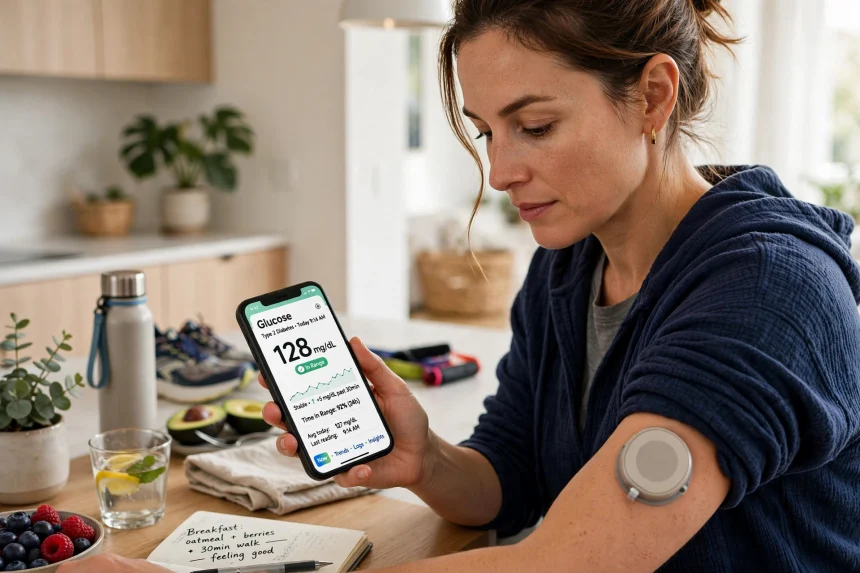
For many adults living with type 2 diabetes, checking blood sugar has meant finger-prick tests at set times of day — useful snapshots, but snapshots that miss everything happening in between. New trial evidence reported this week suggests that wearing a continuous glucose monitor can change that picture in a surprisingly practical way: adults who do not use insulin spent about five more hours a day inside their target blood sugar range when they used the devices.
The finding comes from the largest clinical trial of its kind, published in the New England Journal of Medicine and summarised by the University of Colorado Anschutz Medical Campus. Until now, most of the strongest evidence for continuous glucose monitors — small sensors worn on the arm that read glucose every few minutes — came from people who use insulin. This study extends the benefit to a much larger group: people managing type 2 diabetes with diet, activity and oral medication alone.
What the Trial Actually Found
Researchers followed adults with type 2 diabetes who were not on insulin and compared those given a continuous glucose monitor with those using standard care. The monitor group spent roughly five additional hours each day in the healthy target range. That matters because time in range is increasingly seen by clinicians as a better measure of day-to-day control than a single quarterly lab result. More time in range generally means fewer damaging highs and fewer risky lows.
Just as important, participants did not need intensive coaching to get the benefit. Seeing a reading rise after a meal, or fall after a short walk, gives immediate feedback that a finger-prick twice a day simply cannot match. Behaviour changed because the information arrived at the moment a decision was being made — what to eat, whether to walk, and when to stop.
Why Feedback Changes Habits
Health psychology has long shown that feedback loops drive behaviour more reliably than willpower. It is the same principle explored in our look at why your brain loves a bargain: people respond to what they can see clearly and immediately. A glucose graph makes an invisible process visible. A plate of food stops being an abstract warning and becomes a curve you can watch, learn from and flatten next time.
That learning appears to stick. Trial participants reported greater confidence in managing their condition and a better understanding of how sleep, stress and portion size affected their readings. For clinicians, the shared data also makes consultations more specific — instead of asking how things have been in general, a doctor can discuss the exact pattern after breakfast or on workdays.
Who Could Benefit Most?
The clearest candidates are adults whose blood sugar is above target despite oral medication, people who experience unexplained swings, and anyone newly diagnosed who is still learning how their body responds. The Centers for Disease Control and Prevention notes that type 2 diabetes affects tens of millions of adults and that good daily control reduces the risk of heart, kidney, nerve and eye complications. A tool that adds five healthier hours a day, every day, compounds into a meaningful long-term difference.
There are caveats. Sensors cost money, coverage varies widely, and not everyone wants a device on their arm around the clock. Skin irritation, alarm fatigue and anxiety from constant readings are real concerns for some users. The trial also does not mean monitors replace medication, regular check-ups or dietary advice — they make those measures work better by showing whether they are working.
Practical Tips If You Try One
Start with curiosity rather than perfection: wear the sensor for two weeks and look for patterns instead of judging single readings. Keep meals and walks logged simply, even in a phone note, so curves have context. Review the data with your care team before changing any medication, and agree on a target range that fits your age, history and other conditions. Finally, give yourself breaks if constant data feels stressful — many people use monitors in cycles and still keep most of the benefit.
The Bottom Line
Continuous glucose monitors were once reserved for insulin users. The newest and largest trial in non-insulin type 2 diabetes shows they can deliver about five more hours a day in a healthy range for a far wider group. For readers choosing between gadgets and proven health tools — a decision we also explored when looking at how to choose products that genuinely match your lifestyle — this is technology earning its place: simple, informative and directly tied to better daily decisions.