

A national e-commerce brand can market to the entire country. A local bakery, dental practice, auto repair shop or landscaping company cannot, and does not need to. Its customers live or work within a few miles, often find it through a quick phone search, and decide within minutes whether to call, visit or keep scrolling. That changes how the customer acquisition funnel works. The stages are familiar, but the tactics, timing and priorities look very different when your market is a single town or neighborhood.
The infographic below lays out a seven-stage funnel built specifically for local businesses, from first becoming visible in local search to turning happy customers into a steady source of referrals. Each stage has its own goal and its own leaks. The sections that follow explain what happens at each stage, which tools and tactics matter most, and how to measure whether it is working without a marketing department.
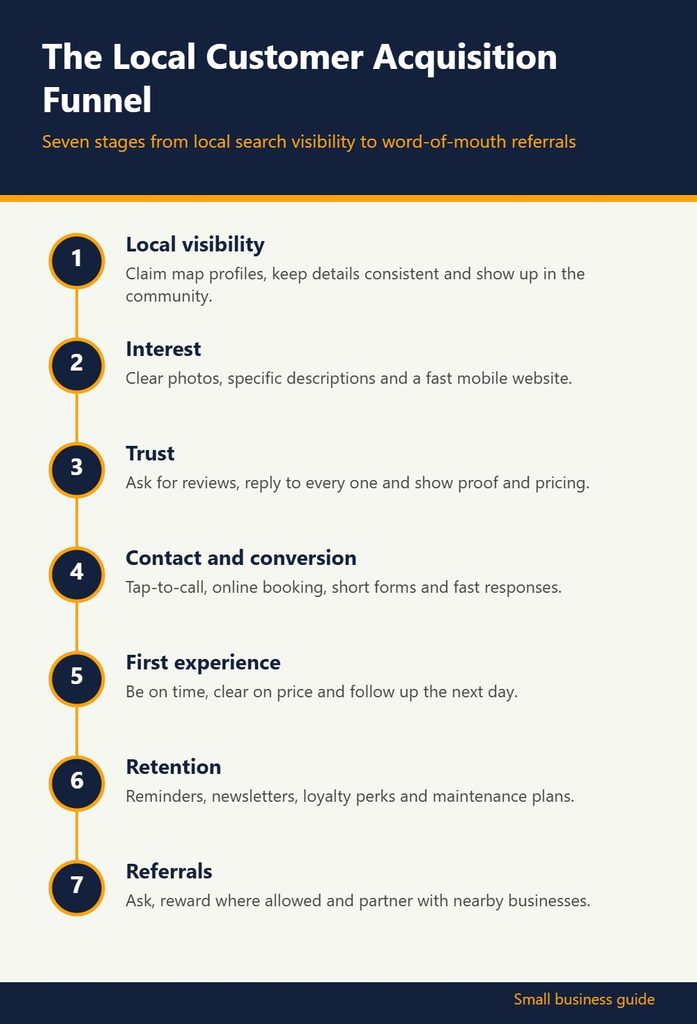
Stage 1: Local Visibility
Before anyone can choose you, they have to find you. For most local businesses, that discovery happens on a phone, through a search like “plumber near me” or “best tacos downtown,” or by browsing a map app. Your goal at this stage is to show up where those searches happen.
The foundation is your business profile on the major map and search platforms, especially Google Business Profile, along with Apple Business Connect and Bing Places. Claim and verify each profile, choose the most accurate primary category, add your service area or address, hours, phone number, website and high-quality photos. Keep hours updated for holidays. An outdated profile that sends a customer to a closed door is worse than no profile at all.
Consistency across the web matters too. Your business name, address and phone number should match on your website, social profiles, industry directories and local listings such as your chamber of commerce. Inconsistent details confuse customers and can make it harder for search engines to trust your information.
Beyond search, local visibility includes physical presence: clear signage, vehicle wraps for service businesses, sponsorships of youth sports teams, booths at community events and partnerships with complementary businesses nearby.
Stage 2: Interest and First Impressions
Once someone sees your business, they quickly decide whether to look closer. This is where photos, your business description, your website and social media do the heavy lifting.
On your profile and website, answer the questions a new customer has in the first ten seconds: What do you offer? Where are you? Are you open? What does it cost, roughly? Why should I choose you over the business two blocks away? Specifics beat slogans. “Same-day brake repair, most cars done in two hours” is far more persuasive than “quality service you can trust.”
Your website does not need to be elaborate, but it must load quickly on a phone, display your phone number and address prominently, and make the next step obvious. A dedicated page for each main service, and for each town you serve if you cover several, helps both customers and search engines understand what you do.
Stage 3: Consideration and Trust
Local customers compare options, and reviews are usually the deciding factor. People scan star ratings, read a few recent reviews and look at how the business responds to criticism. At this stage, your job is to build enough trust that a stranger feels comfortable picking up the phone.
To strengthen this stage:
- Ask for reviews consistently. The best time is right after a positive experience. A simple text or email with a direct link to your review page makes it easy. Never pay for reviews or offer incentives in exchange for positive ones, as platforms prohibit this and consumer protection rules may apply.
- Respond to every review. Thank happy customers by name when appropriate, and reply to negative reviews calmly, acknowledging the issue and offering to resolve it offline. Future customers read your replies as closely as the reviews themselves.
- Show proof. Before-and-after photos, short testimonial videos, licenses, insurance and professional memberships all reduce perceived risk.
- Be transparent about pricing. Even a price range or starting price helps customers self-qualify and reduces wasted calls.
GrowBizLab publishes practical guides for small business owners on marketing basics, software and operations, which can help when you are setting up review requests or choosing tools to manage them. If that is where you are, visit the site and browse its software coverage.
Stage 4: Contact and Conversion
The conversion moment for a local business is usually a phone call, a booking, a form submission, a walk-in or a request for directions. Every bit of friction at this point costs you customers who were ready to buy.
Make contact effortless. Put a tap-to-call button on your mobile site. Offer online booking if your business runs on appointments. Keep contact forms short. If you cannot answer the phone during busy hours, use voicemail with a clear promise of when you will call back, or a call answering service. Many local businesses lose a large share of potential customers simply because nobody picks up and nobody calls back.
Speed matters enormously. A customer with a leaking water heater will call the next plumber on the list if you do not respond within minutes. Set a target response time for calls, messages and form inquiries, and track how often you hit it.
Stage 5: The First Experience
The first visit or job is where a lead becomes a real customer, and where the rest of the funnel is either supported or undermined. A smooth first experience leads to repeat business and positive reviews. A poor one produces a lost customer and possibly a negative review that affects stage three for everyone who comes after.
Focus on the basics: show up on time, communicate clearly about price before starting work, keep the space clean, explain what you did and make payment easy. Small touches, such as a follow-up text the next day to check that everything is working or a handwritten thank-you note, are inexpensive and memorable.
Capture customer details, with permission, so you can stay in touch. A simple customer relationship management tool, or even a well-organized spreadsheet, lets you record what each customer bought and when they might need you again.
Stage 6: Retention and Repeat Business
Winning a new local customer usually takes more effort and money than keeping an existing one. Retention is where local businesses can build a durable advantage, because a loyal base in a small market is hard for competitors to pry loose.
Retention tactics that suit local businesses include:
- Service reminders. An HVAC company can remind customers about seasonal maintenance; a dentist can send cleaning reminders; a groomer can prompt rebooking every six weeks.
- Email or text newsletters. Share seasonal tips, new services and occasional offers. Keep it useful rather than constant.
- Loyalty programs. Punch cards, points or a free service after a set number of visits work well for cafes, salons and car washes.
- Membership or maintenance plans. Recurring plans provide predictable revenue and keep you top of mind.
Follow applicable rules for marketing messages, including getting consent before sending promotional texts and including unsubscribe options in emails.
Stage 7: Referrals and Advocacy
The final stage closes the loop. Satisfied customers tell neighbors, post in community groups and leave reviews, feeding new prospects back into the top of the funnel. Word of mouth is powerful in local markets because people trust recommendations from people they know.
Encourage it deliberately. Ask happy customers whether they know anyone who might benefit. Offer a referral reward, such as a discount for both the referrer and the new customer, where permitted in your industry. Make sharing easy with referral cards or a simple link. Build relationships with other local businesses that serve the same customers; a real estate agent, a home inspector and a moving company can send each other steady referrals.
Consider a neighborhood bike repair shop. After each repair, the owner texts a short thank-you with a link to leave a review and a code that gives a friend fifteen percent off their first tune-up. He also leaves a stack of cards at the coffee shop next door, which in turn has its menu posted on the bike shop’s counter. None of this costs much, but over a season the shop can trace a meaningful portion of new customers to referral codes and the coffee shop partnership, and those customers tend to arrive already trusting the business.
Participating visibly in the community, through sponsorships, volunteering or hosting events, also generates goodwill that turns into word of mouth over time.
Measuring the Local Funnel
You do not need complex analytics. Track a few numbers each month:
- Profile views, searches and actions such as calls and direction requests from your business profile insights.
- Website visits and contact form submissions.
- Number of inquiries and how many became paying customers.
- Average response time to new inquiries.
- New reviews and average rating.
- Repeat customer rate and number of referrals.
Ask every new customer how they heard about you and record the answer. Over time, you will see which channels bring in customers and which simply cost money. If you are looking for tracking tools and software that fit a small budget, the guides at GrowBizLab are a good starting point, and you can find out more about options for CRM, scheduling and invoicing there.
Where Local Funnels Usually Leak
- Incomplete or outdated business profiles.
- Too few recent reviews, or unanswered negative ones.
- Websites that are slow or hard to use on a phone.
- Missed calls and slow callbacks.
- No system for staying in touch after the first purchase.
- Never asking for referrals.
Fixing the biggest leak usually delivers more than adding another marketing channel. Walk through your own funnel as if you were a new customer: search for your service, look at your profile, visit your website on a phone, call during a busy hour. Wherever the experience feels slow or confusing, that is where to start. Strengthen one stage at a time, and the whole funnel will produce more customers with less effort.